Monday, January 28, 2013


Our day began with the diamond factory in Tiberius. We managed to get through the tour, the movie, and visit the show room and we did not buy anything!!!   

The citizens of Israel are taxed, and they can be anywhere from 32% up to 50%. Israel's government does provide assistance to their citizens who live below the poverty line. They are provided with socialized medicine and they have the choice of several different HMO's, but they don't have vision or dental insurance provided. They are charged for the health insurance, and have to buy additional coverage if they would like.

Yesterday was the election in Israel. (1-22-13)

The Sea of Galilee was next. We were able to take a boat ride on wooden boat. The weather was wonderful, it was warm, but overcast. The weather was really hot yesterday and Avi (our tour guide) said this is why it is hazy. Once we were boarded the boat, we were leaving the dock and over the inercom came the Star Spangled Banner, and they raised the American Flag.   Avi also had a special treat, upon request from Wild Bill (Bill Dawson), he played Country Roads while we were on the Sea of Galilee. 


The Jordan River, along with two other rivers are the three major tributaries that meet to form the Sea of Galilee. The water level of the sea has raised greatly since the two years before when Mom and Renee visited. The country had experienced a great drought that had been going on for approximately 20-25 years. During this drought they found a boat which was preserved in the mud, and the water level decreasing, allowed them to excavate the boat. It was 2000 years old and found in 1986. Some of the freshwater fish that are in the sea are carp, tilapia, and sardines. The valley is also known as "Valley of the Doves".

Lunch was by the sea. Renee sat in the garden and ate with a cat, while the rest of us ate on the porches and we had pizza!

Our last stop of the day was the Roman ruins that were destroyed by an earthquake, Bet She'an. The theater would seat 7,500 people, and they calculate that at it's peak, the city was home to 120,000 - 130,000 people.  In 749 AD was the damaging earthquake that destroyed much of the area, including Bet She'an.


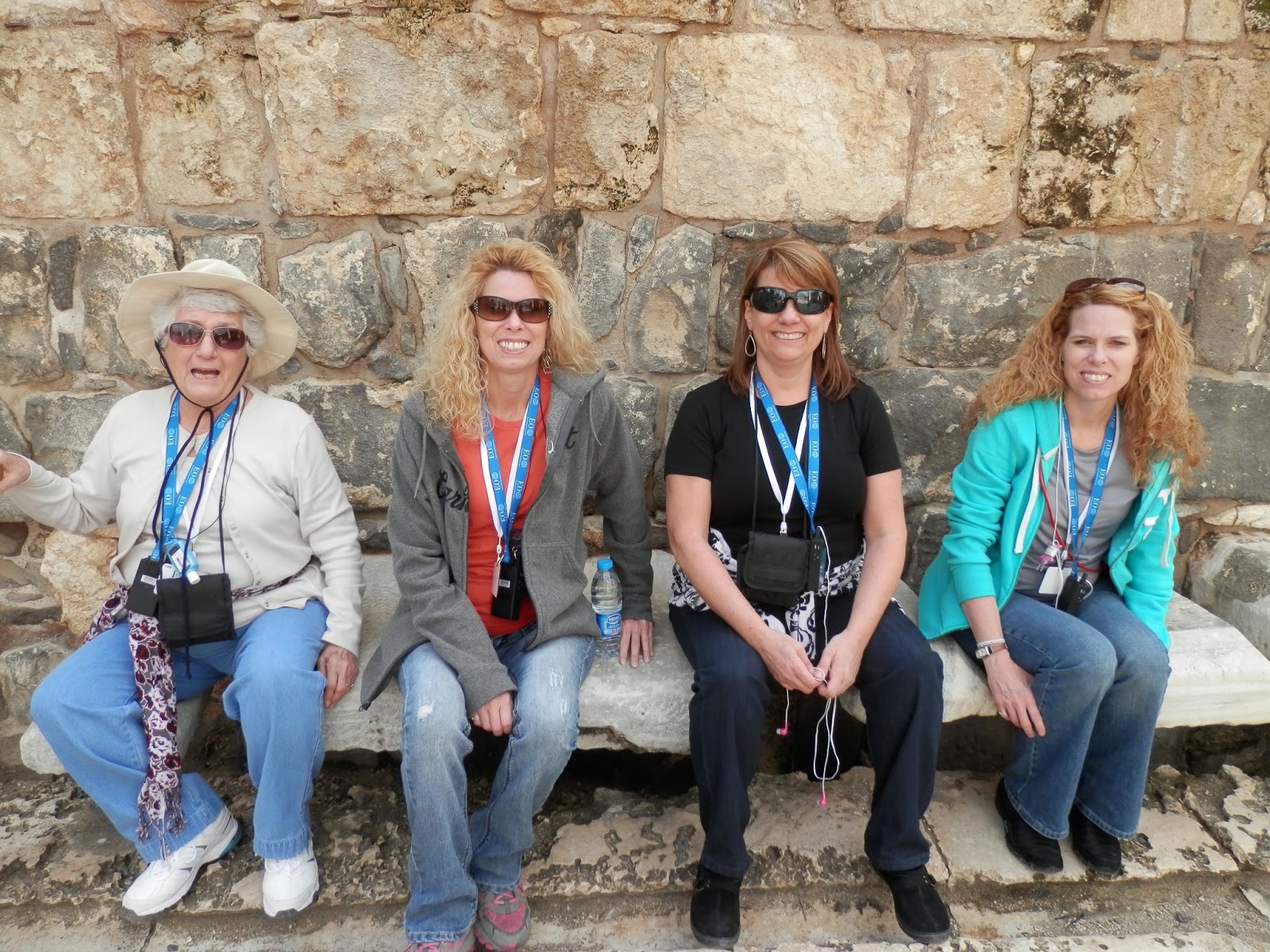
 Ancient restrooms (below)
Louise Henthorn, Renee Goddard, Becky Moyer, Jennifer Eller


We did not get to visit Jerash, but it is the 'twin' to Bet She'an, the same time period, same size, and destroyed by the same earthquake. The earthquake affected all the of big capital cities. Philadelphia (not the one in the US, Jordan had a Philadelphia before the US).

Monday, January 21, 2013

Tel Aviv


We left Jerusalem and traveled through Tel Aviv.  Tel Aviv is only about 100 years old and is a very modern city.  Tel means "old" and Aviv means "spring" in Hebrew.   The diamond trade is big in Israel due to the fact that they are easy to carry to trade.  Today Israel still does the diamond cutting, the best in the world.  We are going to get to see a diamond factory where we will see the people working with the diamonds.  They are building a 'bullet' train track that will be completed in about three years from now.  The train will go from Tel Aviv to Jerusalem, and it will only take 28 minutes to travel the distance, which now takes slightly less than 2 hours.


We have been seeing many American restaurants, KFC (above) and even McDonalds.  Our guide Avi stated that a Happy Meal in Tel Aviv costs $10.00.  Wow!


(left)
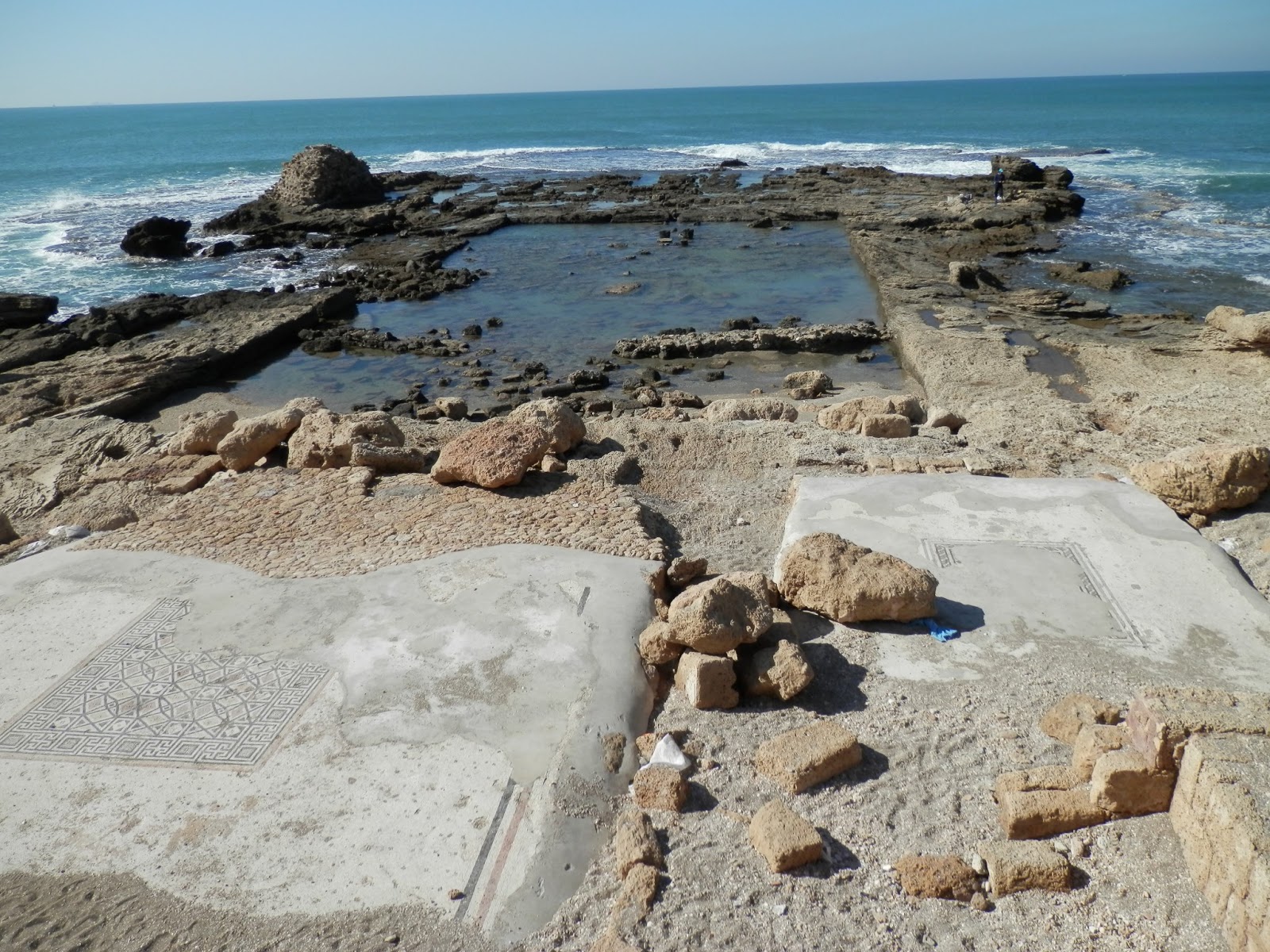
Caesarea was the next stop.   Herod the Great built the port city in 20 BCE.  For nearly 600 years Caesarea was the official capital of what the Romans called "Provincia Judea."  Pontius Pilate ruled from this city.  The remains of the city contain much art work from the Roman period.  There is the remains of an old freshwater pool, surrounded by the saltwater of the Mediterranean Sea.  There are mosaics surrounding the pool.  We walked on the shore of the Mediterranean.


Caesarea has Israel's only power plant that is run by coal that is shipped from Poland.  They have recently found natural gas in Israel, enough to provide the country with power for about 150 years.    Israel is a self-sustaining country, the only thing they have shipped in is oil. Fruits, vegetables, wheat, and other goods come from within the country.

(Right- the power plant)
(Below - the ships port that has the conveyor belt that takes the coal to the plant)


    Mosaic around the pool
(pool surrounded by the sea is below)


The theater above is an ancient Roman theater.  It was renovated in the 1960's and is still used today.  It seats 4500 people and the bottom row on the left is the original, the rest is part of the renovation.  The Rolling Stones have even played here!   
 Roman aqueducts that brought fresh water from Mt. Carmel to Caesarea (left and below) 


Megiddo was our next stop, overlooking the place where it is believed that the final battle will take place, Armageddon.  Megiddo was a major trade route that many roads pass through.  The Jezreel Valley is below Megiddo.  Megiddo has been destroyed and rebuilt 27 times through history, as a result, the ruins create a flat plateau some sixty feet above the level of the surrounding plain.  There are archeological restorations going on in Megiddo, the history spans 3500 years. 

 Over looking Jezreel Valley

We were able to walk to the top, and see the ruins.  We stood atop the Megiddo and looked across the valley, it is very lush and green right now.  We were unable to go through the excavated water systems this time, due to the recent rainfall and snow, the tunnels were flooded. 

(Above and to the right - archeological ruins)


Jezreel Valley (above left and right)


Our next stop was Nazareth.    Nazareth is known for its sweets and coffee.  Nazareth has the largest Arab Christian population in the Holy Land.  We got shop and walk the streets of Nazareth before traveling on to the Sea of Galilee.  Tomorrow we will get to ride a boat on the Sea of Galilee. 

Friday, January 18, 2013

Mt. Nebo and the trip to Israel

At 6:30 a.m. we had to leave our hotel and travel to Israel.  Our driver took us through Amman to show us the residential neighborhoods.  We drove by the United States Embassy, but photos are not permitted. 


   We traveled on "The Kings Highway" from Amman to Mt. Nebo.  As we stood on the of this mountain, we could see the Jordan River Valley, the Dead Sea, Jericho, and Jerusalem.  Early Christians built Mount Nebo's first church in the late fourth century.  Six tombs, from different periods, have been found hollowed out of the rock beneath the mosaic-covered floor of the church.     
  A mosaic

 
(left) The view from Mt. Nebo. 


We went to a shop that you can purchase mosaics, and we could see them making the mosaics. 
      

(Below left) Sign on Mt. Nebo indicating the way to the Dead Sea.   (below right) June, Jennifer, and Renee.  We left Mt. Nebo and traveled through the border from Jordan into Israel.  This process took almost two hours due to the fact that there were many people coming to Israel for celebrations.  You have to go through customs, change busses, and go through checkpoints, one of which you must show your passports.  Finally we board a different bus.  The weather was a warm and sunny 80 degrees when we were finally in Israel. 


Our first stop was at Qumran, the sight of the Dead Sea Scrolls discovery.  The scrolls were discovered in 1947 by some shepherd boys. 
Street vendors and many families are in Jericho during this time. 


(below) In Jericho we were able to visit the ruins of the ancient city.  Both photos below are looking out on Jericho. 


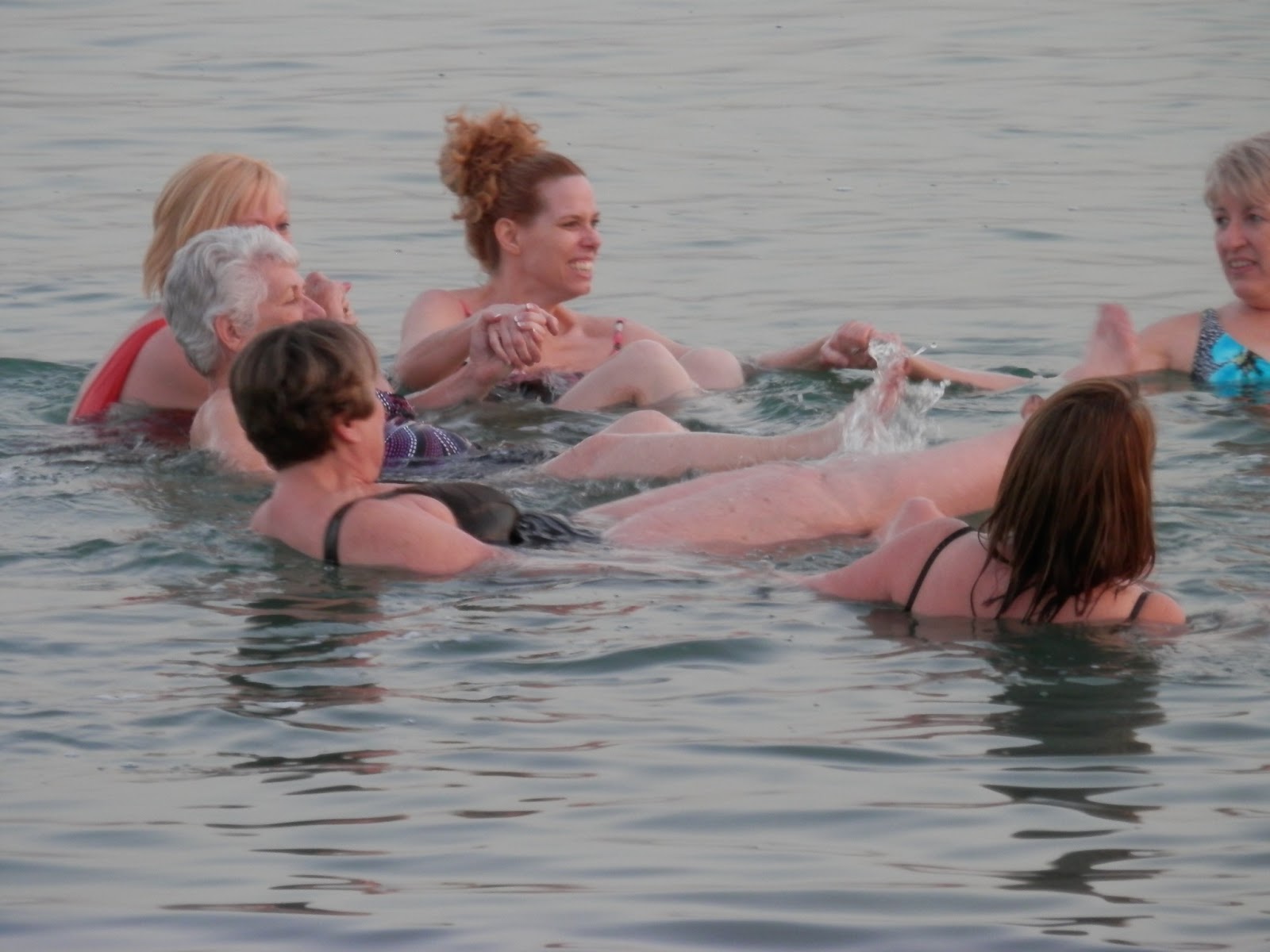
The Dead Sea (left) has a high percentage of salt in the water.  The salinity is 37% and you must use caution when getting in the Dead Sea. 


Here I am 'swimming' in the Dead Sea.  You cannot really swim, but due to the density of the water, you actually float.  You should be careful to float on your back, and not your front since there would be danger of splashing the water in your face.  You should never put your head under the water in the Dead Sea.  Do you think anything lives in the Dead Sea?


Thursday, January 17, 2013

Petra, Jordan

Today is finally our first day to tour after all the traveling yesterday. The bus ride to Petra only took 3 hours! Petra, or Selah, means rock, and Petra is known as the Rock City. Our tour guide is Michel (pronounced like the American female name "Michelle") and our bus driver is Moontheir.  We also have armed police security with us on the bus. (above, right JuneCozart, my mother, and our police security)
 
The population in Amman, Jordan is 2.5 million.  The population of Jordan is 8 million.  The dominate stone in Jordan is limestone and the majority of the buildings are made of it.  The elevation in Amman is 3,000 feet above sea level.  If you were to drive about half an hour, you would be at the Dead Sea, elevation 1,312 feet below sea level. 

Eighty percent of the land in Jordan is desert.  The main resources are: #1 tourism and archeology, #2 Phosphate mixes, #3 Agriculture.  Produce is raised in hot houses, plastic house, and they are responsible for 6-8 times more than produce outside.  There are 18 million olive trees in Jordan.  In Lebanon, there are olive trees that are 5,000 years old, and they are still producing olives. The land is vast but dirt and rock mostly. They irrigate the fields to maintain agriculture as their resource.

We saw many Bedouins, formerly known as Nomads, a term that is no longer used.  Their main income is raising livestock such as sheep, camels, goats, donkeys, and llamas.  

Last week in Jordan, it rained and snowed for five days.  They received more rainfall in these five days than they usually have in an entire year.  The last time they had this much rainfall at once was 60 years ago.

Jordan is a kingdom, and is currently ruled by King Albdullah, and Albdulla means "the servant of God".  Currently they are holding the Parliament elections.  The government is divided into 12 districts, which would be similar to US counties.  They will hold the elections on January 23, and they will be electing 120 senators. 

Military service is compulsory, required, for the men to serve for 6 months.  It used to be three years of required service, but in 1958 it was changed and only required two years of service. In 1991 it changed again and did not require ANY services.  After 16 years, the king decided that the mandatory
service was again needed, and now requires men to serve a minimum of six months in the army. It is not required for women to serve, but 11% of the Jordanian army are women. 

               Jordanian School to the right, notice the snow. 
The schools in Jordan are mostly private schools, Christian schools.  They are expensive, but there is government schools that are free.  It is compulsory, mandatory, that children attend school for nine years, but after the nine years, it is no longer mandatory.  They begin school at the age of five and most will go for twelve years of schooling, and then go to colleges and universities.  There are 36 universities in Jordan, both public and private.  60% of the population  Jordan are under 20 years of age.  Thousands of students come to Jordan from other countries to finish their education.  Jordan has the highest number of educated people in the Arab Nation.    


(Left, Patty Goudy, Michel, and Jennifer Eller)


          The Obelisk Tomb
         (Right, Jennifer Eller)

The tour allowed us 3 hours to tour Petra. We ended up taking four and a half hours, but our guide and bus driver were quite patient with us. In order to see all of the Petra site that has been excavated, you would need a whole week. With the time allotted  us, we saw less then 15%. The percentage we were able to see though was spectacular! Amazing rock formations with evidence of the different minerals in the stones made them a very pleasing site to see.
(left - facades
There were many tombs we could see from the path. The outside of tombs are called facades, and there are 1,200 facades excavated, and many more yet to be exposed.  Horses or horse drawn carriages were available to ride to and from the bottom of Petra (for a price), which was about a 1.25 mile hike. You had to be cautious though, the carriages moved quickly and the path was quite narrow. Petra's main claim to fame is from the movie Indiana Jones and the Temple of Doom. Even though only approximately the last 15 minutes of the movie was actually filmed in Petra at the Treasury site, it still increased tourism to the site after the movie was released. 

Bab Al Sig
'Bab' is Arabic for gateway and the Sig is the gorge that leads to the ancient city. To the right is one of the beautiful views we saw on the walk through the Sig. 


(left) The first view of the Treasury (Al Khazna). 


We walked all the way down so we could see all of the things you would miss on horseback or carriage. It was well worth the walk. We did ride camels part of the way on the return, and walked some, and then a horseback ride to the top! Perfect end of the tour for today!

(Above)
Renee Goddard and Jennifer Eller

(Right) Jennifer Eller and Renee Goddard on camels, June Cozart leading one


(Below) Jennifer Eller at the Treasury.  (Below right) Renee Goddard, Jennifer Eller, and June Cozart.